Apply
Apply
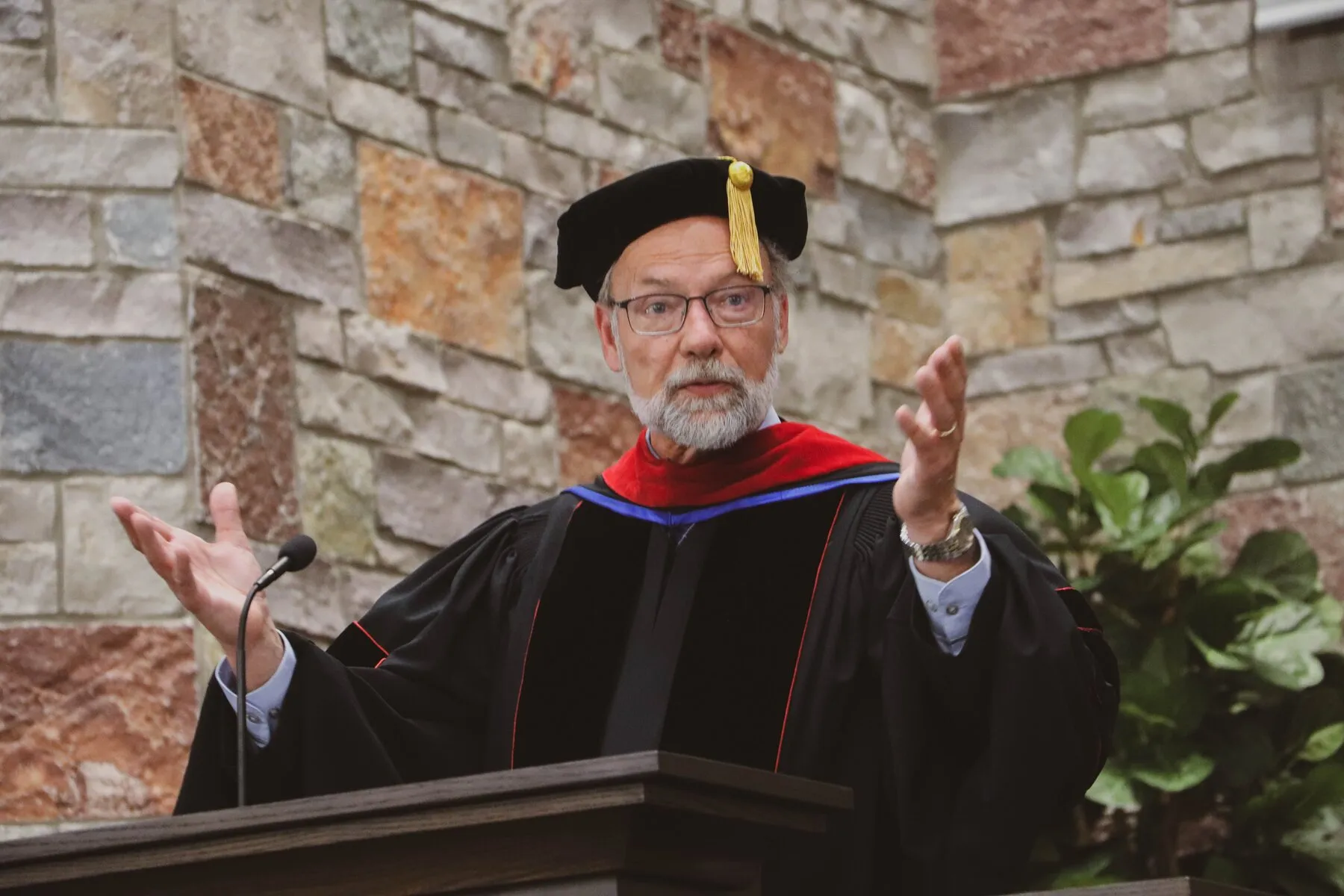
A professor in academic regalia speaking at commencement
Programs

Doing Ministry While Learning

Mid-America provides an educational experience that gives you the tools for a lifetime of ministry, no matter where God calls you.

You will receive solid biblical instruction in a residential community that challenges the head, exercises the hands, and nurtures the heart.

Apply

Areas of Interest

Sound Christian scholarship is crucial in equipping you for effective Christian ministry.
Degree program

Master of Divinity

Apply

The Master of Divinity (M.Div.) degree program prepares you for ordained gospel ministry as a pastor, chaplain, missionary, and evangelist. The health of the church and society depend on the faithful ministry of the Word of God. The Master of Divinity will train you to effectively serve the church as a knowledgeable pastor with a servant heart. Because the Seminary Board and faculty believe that Scripture limits the role of official teaching and leadership in the church to qualified men, only men are admitted to the Master of Divinity program. Women are encouraged to enroll in the Master of Theological Studies program.

Location
Dyer, Indiana
Classroom credits
104
Apprenticeship credits
10
Years to complete
3–4
Requirements for Admission

To qualify for admission to the Master of Divinity program you must be a dedicated Christian who has earned a bachelor’s degree or its equivalent, with a grade point average of 2.67 (B-) or higher. If you fall below this average you may be admitted, but the Registrar will review your seminary academic work on a regular basis. If you are without a bachelor’s degree, you are evaluated on an individual basis.

Exceptions for Admission

Mid-America recognizes that increasing numbers of students are seeking Master of Divinity degrees after some time in the work force. These students may not have followed a traditional pre-seminary track of college education and may need special instruction to meet prerequisite requirements. The Seminary works closely with these students to meet their needs.

A limited number of students who have not earned the B.A. degree, but whose life experience suggests that they would be suitable M.Div. students, may apply for the M.Div program. The following “core” prerequisites are strongly recommended for such non-B.A. degree students: two college-level English courses, one of which must include grammar and composition; two college-level history courses, one of which must include classical history; two college-level courses, one of which must provide a survey of ancient philosophy; and four college-level biblical or Koine Greek courses.

For further information, consult the catalog.

Course Sequence

We seek to give students the tools for a lifetime of ministry. Our curriculum stresses two governing ideas. First, there is a repeated combination of study and application that teaches students how to translate the theology they learn into preaching and teaching constructed with solid content and sound method. Second, there is a strong emphasis on the classical disciplines of original language study, biblical interpretation, doctrinal and practical studies, and the history of the church with application that is relevant in the 21st century.

It’s important to note that while Greek language studies are propaedeutic and not part of the formal M.Div. course sequence, this does not diminish their importance. In fact, knowledge of both Greek and Hebrew is required for the exegesis courses and, consequently, for completing the degree. Our commitment to rigorous language study remains steadfast, ensuring that students gain a robust foundation in these critical biblical languages.

A Master of Divinity requires 104 course hours and typically takes 3–4 years to complete. You will also earn 10 Ministerial Apprenticeship Program credits.

M.Div. Course SequencePDF

Part of every M.Div.

Ministerial Apprenticeship Program

Mid-America Reformed Seminary believes that mentoring should be part of all ministerial training. From the beginning of Mid-America’s existence, pairing the Master of Divinity student with an experienced pastor has been an integral aspect of the Seminary’s training. Students participate in mentoring relationships not simply during the summer, but throughout their seminary career. Veteran ministers and their congregations partner with the Seminary in preparing students to be pastors as well as preachers.

Location
Dyer, Indiana
Practica
8
Summer internship
2
Minimum assignments
20
Course Description

Mid-America recognizes the necessity for practical experience in preparing a man for ministry. It also realizes that there is no better way for a student to gain that experience than by being paired with a veteran pastor in a mentoring relationship. This relationship between the seasoned pastor and the M.Div. student is the focus of the Ministerial Apprenticeship Program (MAP). This program allows the student to gain field experience throughout his seminary career. A Master of Divinity student automatically becomes part of the program upon his entrance to the Seminary.

Field education is a part of seminary training, but it is always closely connected to the life of the church. Students whose denominational requirements differ from, or go beyond, those of the MAP should ensure that necessary requirements are incorporated as much as possible into their field education.

The program is under the supervision of the MAP Director in consultation with other faculty members. Working with the student, the MAP Director helps to secure a minister to supervise the student’s fieldwork. The supervising minister should be a member of the Mid-America Reformed Seminary Association, if possible. Ordinarily the student will make the supervising pastor’s congregation his church home, and his relationship with the pastor and congregation will continue for the duration of the student’s seminary training. Any financial remuneration is incidental to the established purpose of the program.

The student’s work will be evaluated at designated times each year so that his competency in several areas may be tested and improved. The student, the pastor, and the faculty will meet at the end of the junior year to evaluate specific areas of growth in the student’s spiritual, personal, theological, and ministerial life. Near the end of the middler year, a consultation with the student is conducted in the presence of the faculty. The faculty helps the student determine his suitability for the ministry and counsels him with regard to his continuing studies. If necessary, the senior year concentrates on any areas that need improvement.

Components
  1. Regular contact with the pastor, consistory or session, and congregation by the student during the first year of study in order to gain a broad acquaintance with the life and activities of the congregation. It is the responsibility of the student to see that his work is being supervised and regularly evaluated.
  2. Involvement in the following areas of the work of the church:
    • Teaching a church school (catechism) class, or leading a society or Bible study
    • Attendance at a specific number of meetings of consistory or session, diaconate, and classis or presbytery
    • Direct contact with the evangelism program of the congregation
    • Involvement in calling on the sick, shut-ins, and others needing pastoral care
    • Exhorting in the worship services of the congregation and area congregations.
  3. At least two summers of service in a congregation, either as student assistant to a pastor or in a vacant church—in which case the student will be supervised by a pastor in a neighboring congregation, whenever possible. Each summer assignment is to be at least ten weeks in length.
Reports

We’re pleased to provide digital versions of our MAP forms to streamline the process for students and churches:

  • Supervisor’s Report: to be completed by the student’s direct supervisor in their ministerial apprenticeship.
  • Council/Session Report: to be filled out by the church council or session overseeing the student’s apprenticeship.
Degree program

Master of Theological Studies

Apply

If you desire theological education but do not seek ordination, the Master of Theological Studies program is for you. The MTS degree serves as an avenue for further graduate study or as a platform for enhanced theological knowledge that may augment your training received in other fields. For example, church leaders (who may serve as elders, deacons, Bible study teachers, or church education teachers), Christian school teachers, and others serving in Christian ministry may wish to complement their training and experience with graduate-level theological education. As a student, you can choose a concentration in either biblical studies or historical/theological studies.

Location
Dyer, Indiana
Classroom credits
65
Options
Biblical Studies or Historical/Theological Studies
Years to complete
2–3
Course Sequence

We seek to give students the tools for a lifetime of ministry. Our curriculum stresses two governing ideas. First, there is a repeated combination of study and application that teaches students how to translate the theology they learn into teaching constructed with solid content and sound method. Second, there is a strong emphasis on the classical disciplines of original language study, biblical interpretation, doctrinal and practical studies, and the history of the church with application that is relevant in the 21st century.

A Master of Theological Studies requires 65 classroom credits and typically takes 2–3 years to complete.

MTS Course Sequence: Biblical StudiesPDFMTS Course Sequence: Historical/Theological StudiesPDF

Requirements

To enroll in the MTS program, you must be a dedicated Christian who has earned a bachelor’s degree or its equivalent with a cumulative grade point average of 2.67 (B-) or higher. For more information on the application process, please see the admissions page. This process should be completed before May 1 of the first year of study.

Program Options

The MTS program consists of the same rigorous academic work as the M.Div. program, but without the requirements associated with preaching and ministerial studies. The MTS program offers flexibility by allowing students to concentrate on one of two areas: Biblical Studies or Historical/Theological Studies.

Biblical Studies Concentration

The biblical studies concentration provides a thorough acquaintance with Hebrew and Greek language study, together with in-depth study of the canon, history, and interpretation of both Old and New Testaments. The concentration is filled out with course work in the ecclesiastical and doctrinal divisions of the curriculum.

Historical/Theological Concentration

The historical/theological concentration includes biblical language courses (Hebrew and Greek) and emphasizes church history, apologetics, and theological doctrines.

The Capstone Project

The capstone project is the culminating exercise for the Master of Theological Studies degree at Mid-America. Students have the option of one of two possible tracks:

Research-Based Capstone

In this project, the student will answer a conceptual research question or a practical research question. Using the content and methodology learned during the course of study, students will offer a thesis and defend it through the presentation of research, analysis, and conclusions. This capstone aims to prepare students for further academic work in and/or contribution to their area of interest.

Reflection-Based Capstone

The reflection-based capstone project is a detailed engagement with, and intellectual reflection on, chosen degree content. In this project, the student will substantively recount (using lecture notes and assigned readings from coursework completed) and explore further (via additional data gathered through research) selections from what the student has learned in their course of study. For this capstone project, the student will define the chosen topic, situate it within its academic context, and then reflect on its formative significance for their chosen area of possible future service.

Study without a degree

Non-Degree

A student not enrolled in either the Master of Divinity program or the Master of Theological Studies program who is taking a course for credit is classified as a Non-Degree Student and is not required to meet entrance and course prerequisites. A Non-Degree Student should contact the Admissions Office and request the Non-Degree Student Application form. This serves as both the application and registration form for the Non-Degree student.

Apply Admissions Office

Auditing a Course

If you do not wish to enroll as a degree or non-degree student, you may enroll as an auditor. Auditors must pay the required tuition and fees, obtain written consent of the instructor, and audit only courses for which there are adequate classroom facilities. An auditor should contact the Admissions Office and fill out the Non-Degree Student Application form. This serves as both the application and registration form for an auditor. Students may not change from audit to credit after the semester deadline for changing courses. Permission and registration for auditing are to be obtained from the Registrar.

Auditors are granted a certificate of completion for each course that they audit. When all the courses in one of the four main divisions have been audited, a divisional certificate of completion is granted. While having no official academic standing, such certificates demonstrate that the recipient has been involved in continuing education. In some cases, the certificates satisfy requirements that ecclesiastical or other bodies may have for members’ continuing education. More narrowly focused certificates may be awarded upon request.

Ready to take the next step toward faithful, well-grounded service in Christ’s church?